
15 Nov 1985: the signing of the Anglo-Irish Agreement
It is forty years since the day Margaret Thatcher and the Taoiseach, Garret FitzGerald, met to conclude their historic agreement at Hillsborough Castle, County Down.
Presented from the British side at the time as a modest but useful step, almost consciously downplayed, its significance has only grown across the decades.
From this page you can access conveniently the principal papers covering the negotiations from the British archives.
The thinking behind the Agreement: the "basic equation"
Below is a link to almost 500 items from our archives, a comprehensive selection of material on the Agreement mostly drawn from MT's files at No.10.
The story begins early in 1983, following the return of Garret FitzGerald to office in the Republic at the General Election of November 1982. The initiative came from the Irish side, although not without encouragement from British officials, who quietly raised Irish hopes of a joint approach. After the Anglo-Irish Summit at Chequers in November 1983 very secret talks began between Irish and British officials to see whether a deal could be done on the basis of what the negotiators called "the basic equation" - some form of political involvement for the Irish in Northern Ireland in return for formal Irish recognition of the Union.
The papers show that MT was sceptical of the negotiations from the first, not expecting them to succeed, perhaps not even believing they could or wanting them to. But it is equally clear that she was in two minds on this topic, an unusual and uncomfortable thing for her. Faced with horrifying violence within the territory of the UK, all her instincts were to act rather than to sit in passivity. As she told her cabinet in June 1984: "It was necessary at this juncture to look further ahead in Ireland than the British Government had done before. Ten thousand British soldiers could not be left in Northern Ireland forever". The truth is that she had no alternative policy to offer to that of negotiation with the Irish, so that her scepticism slowed and sidetracked the talks rather than derailed them.
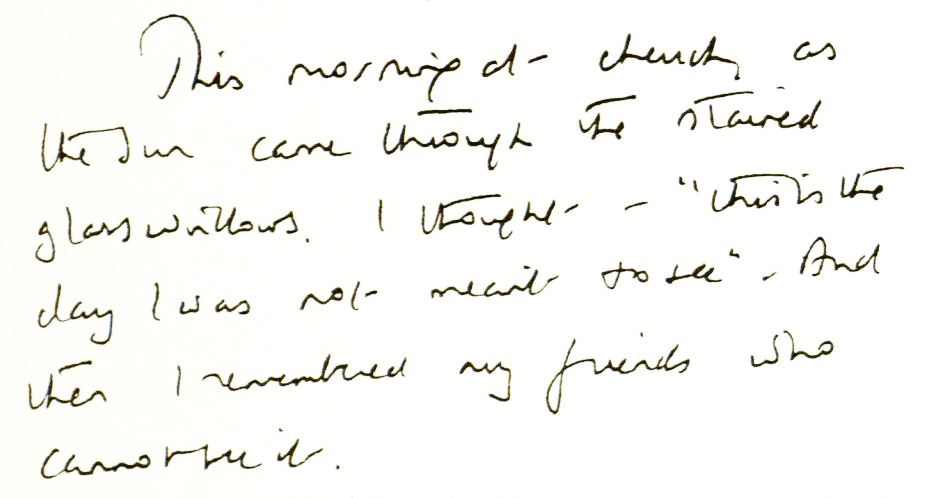
Irish policy has always been a thing apart in the history of the British state, not following standard patterns and rules. Precedents do not apply, or at least do not bind. Almost a century before Hillsborough the Conservative Party had attempted to smother agrarian unrest in Ireland by buying out the landlord class, a policy known as "Killing home rule by kindness", an extraordinary use of state power it would never have contemplated in any other part of the UK (and one wholly unsuccessful). Curiously enough the phrase appears in MT's handwriting among notes she jotted down when her government cancelled an understanding with the Irish to import natural gas from Kinsale. She entered such territory at her peril, but what choice did she have?
Yet for MT, the "basic equation" had a basic flaw, to which she returned again and again however often she was persuaded to endorse it. The flaw does much to explain why she felt so torn. She felt that when you stripped it down, the basic equation meant that the Republic was looking to exact political concessions from Britain in return for doing more to combat terrorism. The thought outraged her - and outraged the Irish side too, which forcefully denied it. From the Irish perspective the point was to find a way to make the institutions of Northern Ireland, particularly those of law enforcement, more acceptable to the minority and so to cut support for terrorism. She endorsed that reasoning herself sometimes, but never wholly lost her dark suspicions.
Deepening MT’s doubts about the process was the fact that Unionist opposition to any role for the Republic in Northern Ireland was so strong that it was judged impossible to involve them in the negotiations: they would simply have used their knowledge to wreck the process. By contrast, the nationalist SDLP was consulted from the first and had a significant impact on the outcome. But the result was to leave MT open to the charge of betraying natural allies. They duly condemned her, some very bitterly. On the eve of the agreement Enoch Powell warned her in the Commons: “Does the right hon. Lady understand—if she does not yet understand she soon will—that the penalty for treachery is to fall into public contempt?” She replied that he would understand how deeply offensive she found the comment. And she was shaken to lose by resignation one of her closest political friends, her former PPS Ian Gow, who five years later was to die at the hands of the IRA.
Reading the historical records of the negotiation through its many twists and difficult passages, at moments very fraught, it would be possible to see the successful conclusion of the Anglo-Irish Agreement as close to a political miracle. It might have been derailed many times in the course of the two years the negotiations continued. But in truth there were large forces making for agreement and perhaps the fact that it emerged apparently so much against the odds is simply because the odds were never as much against success as it seemed. It would certainly be wrong to think that MT's bad temper about the process should be seen as evidence that it was close to failure. One might just as reasonably see that temper as evidence that she could not find a way to stop it or did not truly know what was right to do.
The FitzGerald Government pursued the initiative with skill and determination, maintaining a united position despite the natural frailties of coalition. And it had strong support from some on the British side. MT was not quite alone in her doubts - the Northern Ireland Office was generally sceptical, particularly its leading official, Sir Robert Andrew. Several cabinet ministers were unhappy. But the Foreign Office and the Cabinet Office, which led the negotiations for the British, were emphatically convinced and on this topic spoke for the majority in cabinet, the party and the Commons, not to mention the media and public opinion. US politicians also strongly favoured the process, both in the Administration and Congress. Although the President himself was careful not to pressure MT personally, she understood.
One might say MT had her own basic equation by the end of the negotiation. Once the negotiation was over and the agreement ready to sign, she needed to brief the cabinet and seek its formal approval (unthinkable that they should reject it at this point, but there might be messy arguments). Her closest adviser suggested she make a minimal case. The agreement:
concedes nothing significant and is an honest attempt to improve the present situation ... Unionist agitation so far is rather less than might have been expected. … Above all, failure to go ahead now would be a great disappointment to the Americans.
Modest and useful.